
What is Aquamation and why we choose this option?
This section contains technical and scientific information regarding what Aquamation is. For a brief overview of the process, you may skip this section and watch this 2 minutes video.
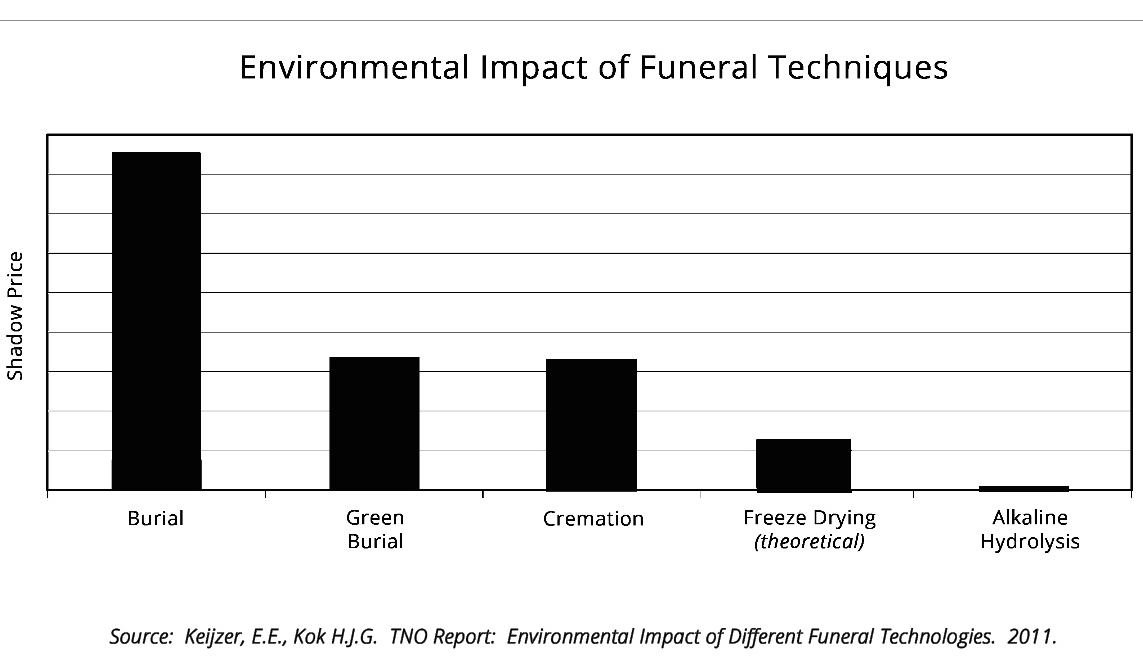
Aquamation, AKA Alkaline hydrolysis (AH) is an alternative to flame-based cremation and burial. This process achieves the same end result as flame cremation, which is reduction of the body to final ash remains. It does so without burning any fossil fuels, without emitting any harmful greenhouse gases, and using 90% less energy than flame cremation. Additionally, mercury is not emitted to the air with alkaline hydrolysis as it is with flame cremation.
The family still receives ash remains, in fact approximately 20-30% more. Anything that can be done with ashes from flame-based cremation, can also be done with ashes from this water-based cremation. The ashes are completely sterile and safe to handle.
By scientific definition, ashes are the inorganic minerals that remain after all organic material has been broken down. The minerals that remain from alkaline hydrolysis, flame cremation, and burial after many years – are the mineral remains of the bones, or calcium phosphate.
Because the temperature of the process is approximately 1500 degrees less than flame cremation, and it uses a very gentle flow of water versus strong combustion, there are more of the mineral remains retained (which are normally lost up the stack).
Description of your pet's remains journey after the euthanasia has taken place
After the euthanasia has been performed, your pet's remains are respectfully placed in the doctor's vehicle. The doctor then makes an identification label for your pet and places this ID tag with your pet so that no confusion can occur on identifying your pet for the rest of the process. From there, your pet's remains will be taken to our office in Brea and respectfully kept cold and clearly identified until the cremation facility's staff picks up your pet. The crematory comes to our office 3 times per week, which means that your pet may stay at our office for 3 to 4 days (rarely longer when there is a holiday involved).
When your pet reached the crematory, if they are not able to start the Aquamation process immediately, your pet will be respectfully kept cold until the process is ready to start (1-3 days).
The tag that was made to identify your pet contains all your pet's information: Name, date of euthanasia, your name, your pet's breed and markings, etc... Using that information, the crematory will create a metal tag with a number unique to your pet. That metal tag will be kept with your pet and with your pet's remains all through the process and will be included in your pet's remains when you receive them.
When the process is ready to begin, the crematory staff will your pet (with the metal ID tag) will be placed in the Aquamation chamber. The process takes approximately 20-24 hours to complete the cycle. Once the cycle is completed, what is left in the chamber are bone fragments (same as with Flame based cremation). However, as the process is water-based, the bone remains are wet and will need to go through a drying process. This process takes another day or two. Once the remains are dry, they will be ready to be processed to transform them into "ashes" in the same manner as if a Flame-Based cremation was done.
After that process, the ashes are packaged in the standard urn or in the custom urn you have chosen. Please note that if you have chosen a custom urn, it may take an additional week or 2 to receive the custom urn, and this adds time to the process).
The Crematory Quality Control staff then make sure that the urn is labeled properly, that the name of your pet and your name are correct and correctly spelled, that your pet's identification tag matches the metal tag that was placed on your pet at the start of the process to make 100% sure that ashes do not get mixed up. This is how you can be assured that the ashes you receive are your pet's ashes and no-one else's.
At that time, your pet's ashes will be ready to be returned to our facility in Brea. As stated earlier, the cremation staff comes to our office 3 times per week, so it can take another 3-4 days for the urn to reach our office.
When the urn reaches our office, our own Quality Control staff make another Quality check to make sure that the urn is in good condition, that your name and your pet's names are correct, that the information matches the label we originally made and matches the information you gave us on the forms. If you requested a hair clipping or a paw print, we will then put those items with the urn and will then be ready to be returned to you.
Any errors such as spelling errors are then corrected. Once the QC process is completed, we will contact you and make an appointment with you either to personally deliver the ashes to you if you had requested so or for you to come pick up your baby's ashes at our office. As stated in the documents you have filled out, pick ups and deliveries are scheduled on the weekend following the day we receive your pet's ashes back from the crematory. If we received your pet's ashes back on a Monday, the appointment is then scheduled for the next Saturday or Sunday, which potentially adds another 5 days before you can receive your pet's ashes.
As you can see, this process involves multiple vital steps and can be a bit lengthy and this is why you may not receive your pet's ashes back for 2-3 weeks after the euthanasia visit.
How Aquamation Works
This process takes place in a state-of-the-art stainless steel system that is powered only by electricity.
Once the deceased pet is placed in the system, the process works by gently circulating a heated solution of 95% water and 5% alkali around the body for an extended period of time (18-20 hours). The flow of the water is similar to that which you would see in a small creek.
Similar to flame cremation, all that remains at the end of the process are the final bone remains (calcium phosphate) and any medical implants. Just as with flame-cremation, the final bone remains are processed into a fine ash powder for return to the family in an urn.
Aquamation (Alkaline hydrolysis or AH) is a proven sterilization technology in which all pathogens are destroyed, as well as all chemotherapy and any drugs that may be present in the pet’s body. Alkali is the chemical opposite of an acid. It is made from sodium and potassium salts. The alkali added to the process is based on the weight of the body, and it is completely consumed by the end of the process.
The amount of time the process takes depends on the temperature of the process. The process typically takes 18-20 hours at 204°F. For comparison, flame cremation typically takes place at 1600-1800°F for 2-3 hours.
The amount of water used in the process is less than a household of 4 uses in a single day – or, the equivalent to 2-3 days use of water for a single individual. The ending process water consists of 96% water, and 4% amino acids, small peptides, sugars, and salts – these are the organics of the body broken down into their most basic building blocks. There is no DNA or RNA remaining. With alkaline hydrolysis, the water and the small amount of remaining organic materials go to the local sanitation system where the water is filtered, cleaned, and recycled to the environment. With flame cremation, these same materials go into the air and subsequently the water. With burial, these materials go into the ground and subsequently the water table.
Unlike flame cremation, the ash content is composed only of the mineral calcium phosphate remains of the deceased pet and does not contain remaining other organic compounds.
The Family’s Perspective:
The numerous end-of-life choices that families must make are very personal. We have learned over time that some common sentiments expressed by families about this option include:
- They are grateful to have a choice.
- They prefer a process that does not use fire/flame nor temperatures close to 2000 degrees F.
- They prefer receiving up to 20% more of their loved ones’ ashes returned to the family.
- They personally perceive this to be a more gentle option than flame-based cremation as the process is similar to what occurs naturally, only accelerated.
- They value the negligible environmental impact of the process.
- As the equipment is on-site (as is possible with this emission-free technology), they are comforted by the fact that their beloved pet is not leaving our care.
Research
Modern alkaline hydrolysis technology as we know it today has been around for 30 years. During this time, the environmental benefits have been vetted by some of the best environmental agencies in the nation. While this option is sometimes recognized as “very new” in the funerary field, beginning in 1995 it was pioneered for respectful disposition of human bodies by prestigious willed body programs like Shands Hospital at University of Florida, MAYO clinic, UTSW Medical School, UCLA School of Medicine, and now many more. It has been available to families as an option in parts of the world, primarily the United States, for over a decade! It is now also available for the processing of pet remains.
Much of the research on alkaline hydrolysis exists due to its heavy adoption in the scientific fields. There are numerous published, peer-reviewed studies and complete environmental analyses on the technology. It is the preferred technology for sterilization and disposition of animal mortalities at universities, research facilities, and pharmaceutical and bio-containment laboratories because of its environmental benefits and its ability to destroy all pathogens.
Sometimes adversaries point to its long history of use in the scientific fields as evidence that this is a waste disposal technology trying to make its way into the funerary profession. This is simply not the case. Animal mortalities must be handled through the same methods we use for final disposition of a human body, including burial, incineration (cremation), and alkaline hydrolysis.
References: Denys G. Validation of the Bio-Response Solutions Human-28 Low-Temperature Alkaline Hydrolysis System.
Applied Biosafety. 2019;24(4):182–188. Keijzer, E. The environmental impact of activities after life: Life cycle assessment of funerals. Int. J. Life Cycle
Assess. 2017;22: 715–730. Keijzer EE Kok HJG. Environmental Impact of Different Funeral Technologies. TNO Report. 2001.