

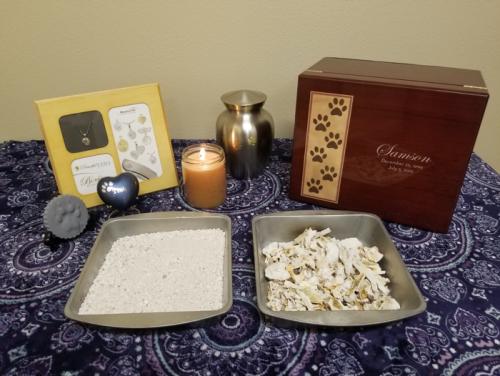
When you receive your pet’s “ashes”, you may be surprised by the appearance. Cremains (CREmated reMAINS) or, in the case of the process we use at Home Pet Euthanasia “Aquamains” (AQUAmated reMAINS) are better words to use than “ashes”. The word ashes may be misleading due to the fact that the cremains are not factually only a fine grey powder like the one remaining after a campfire. The only thing remaining after the cremation process are bone fragments and some organic compounds in the case of flame cremation. In the case of Aquamation, the only thing remaining are the minerals (calcium phosphate) from the bone fragments. There are no "ashes" left from the flesh as the cremation (as well as the aquamation) process entirely consumes all tissues except for bones. This is true for pet ashes and (you may be surprised to learn) for people.
You may see different colors in the flame based cremains and this is normal. There are trace minerals and organic compounds found in the bone fragments. Typically, cremains are grayish/white but you may find black, red, yellow and orange pigments. Green "specks" are very common. As a note, Ashes obtained from the Aquamation process are much nicer looking, much whiter and more plentiful and do not contain remaining organic compounds.
After the cremation, (and once the Aquamains dry in the case of Aquamation, as this process being done with water, the bone fragments require a drying phase), the remaining bone fragments are processed (pulverized) in a special machine. This same process occurs when people are cremated. The final result should be the consistency that varies from that of gravel (similar to cat litter) to a fine powder, depending on the amount of bone fragments (cremains) left and how much processing is done. Care must be taken not to over-process the bone fragments or they turn into an extremely fine powder/dust that blows away. Therefore you may find unprocessed bone fragments in the urn. It is a balancing act between not leaving large bone fragments and not ending up with too fine a powder.
We find that clients are often surprised at the appearance of the cremains. Unfortunately, the widely used term "ash(es)" is a false description of what we are actually left with. What you are left with are simply pulverized bone fragments (“cremains" or “Aquamains”). The process is the same for people as is the final product. Please note that one of the benefits of Aquamation is that the ashes will be more plentiful and whiter.